
08/31/2026
FDA approves daraxonrasib for metastatic PDAC
On August 26, 2026 the FDA approved daraxonrasib (RASONQUE, Revolution Medicines, Inc.) for metastatic PDAC! The FDA approved its use to treat adults with metastatic pancreatic adenocarcinoma who have received at least one prior systemic therapy or who are not candidates for multiagent systemic therapy. This gives access to many more PDAC patients.
We are more than ecstatic to hear this news as it provides a new option for patients whose choices have been limited for far too long.
Find more information here.
08/05/2026
Daraxonrasib expanded access
On May 1st, 2026, The FDA announced that Revolution Medicines could initiate an expanded access treatment protocol for daraxonrasib, its experimental RAS inhibitor. This will give eligible patients an opportunity to gain access to this investigational medicine outside of a clinical trial. Learn more here!
05/28/2026
Promising results of daraxonrasib
In April, exciting news came out that the daraxonrasib demonstrated “unprecedented” overall survival benefit in the Phase 3 RASolute 302 clinical trial in patients with metastatic PDAC. This is significant as to this day, treatment options for PDAC is limited to chemotherapy.
Daraxonrasib is an investigational, oral pan RAS(ON) inhibitor from RevolutionMedicines. In RASolute, it demonstrated a median overall survival (OS) of 13.2 months. Median overall survival is the length of time from the start of treatment that half of the patients in a group of patients diagnosed with the disease are still alive. In a clinical trial, measuring the median overall survival is one way to see how well a new treatment works.
This is incredible news, considering the median OS of the standard-of-care, chemotherapy, is 6.7 months. The doubling in median OS is the first major breakthrough in years in the PDAC field. Even more promising, is that the clinical trial showed that daraxonrasib was generally well tolerated with no new safety signals. In May, the FDA issued a “safe to proceed” letter to RevMed, essentially allowing the company to initiate an expanded access treatment protocol for daraxonrasib for patients with previously treated metastatic PDAC.
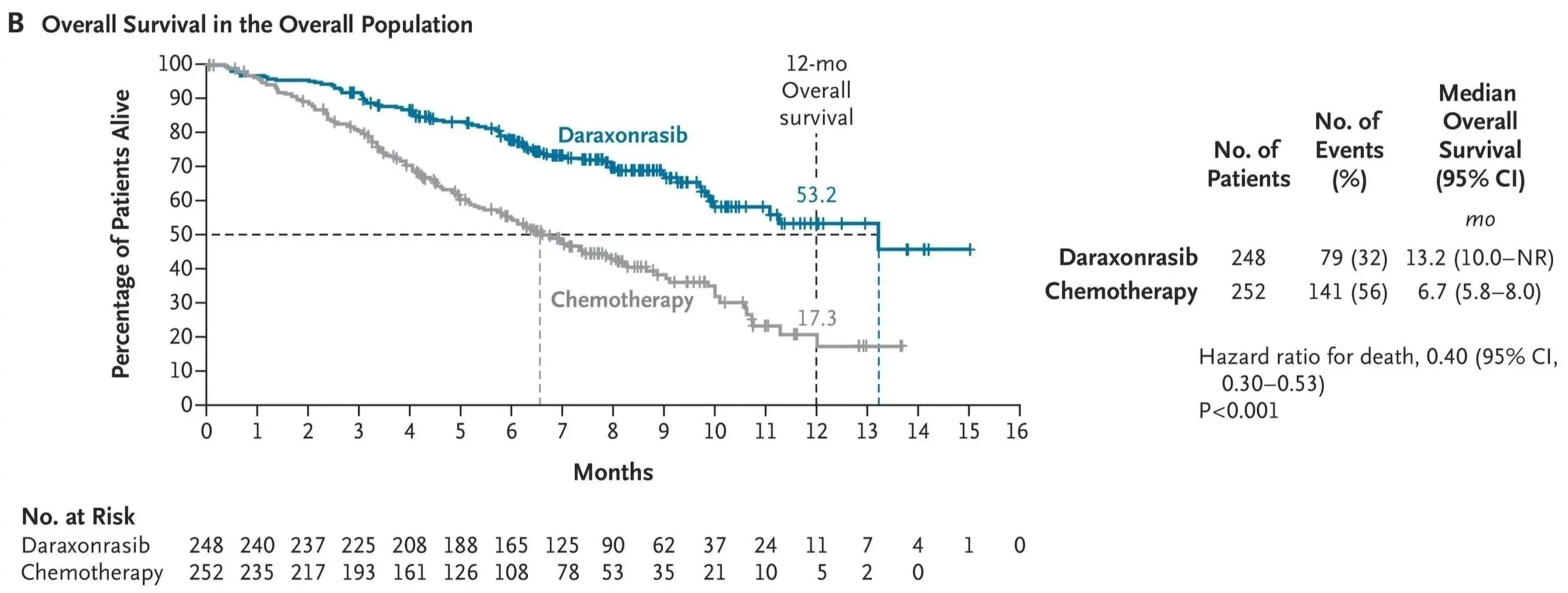
This undoubtedly marks an exciting time for the PDAC field. Presentation of RASolute’s results received TWO standing ovations at this year’s American Society of Clinical Oncology (ASCO) Meeting! We commend everyone involved in the development of daraxonrasib, from researchers to patients in the clinical trials.
11/01/2024
Update on the clinical development of RAS inhibitors for pancreatic ductal adenocarcinoma
Progress since the last update has been amazing and I’m happy to share 4 key points today.
Updated results from the Phase 1 trial of the pan-RAS inhibitor RMC-6236
First interim results from the Phase 1 trail of RMC-9805, a RASG12D-selective inhibitor
New Phase 2 clinical trial of RMC-6236
The launch of the Phase 3 registration trial of RMC-6236
I’ll try to answer potential questions about each of these along the way.
Updated Phase 1 interim results from RMC-6236
On October 25, 2024, Revolution Medicines presented updated interim results for pancreatic cancer patients in RMC-6236-001, a Phase 1 clinical trial of their pan-RAS inhibitor. https://ir.revmed.com/static-files/87b6dcb4-94c9-4e79-9d8c-d21f2bb7aaaf
As a reminder, this is a single-arm trial of RMC-6236 in patients with RAS-mutant, recurrent metastatic cancer. Based on other clinical trials, the expected (benchmark) average survival for such patients is about 6 months. Among the patients in this study treated with higher dose levels, the overall survival had not yet been reached at 14.5 months and 89% percent of patients on the study were still alive after 6 months of treatment. About 90% of patients on the trial experienced “disease control” for some period of time (e.g. either tumor regressions or stable disease). The most common side effects were rash and GI symptoms, generally Grade I or II. Together these results are promising, though one must keep in mind that the trial is neither randomized, nor controlled.
New Phase 1 interim results for RMC-9805
RMC-9805 is a selective inhibitor of G12D-mutant RAS proteins, including KRASG12D, the specific mutation found in over one third of human PDAC cases. The first results from their Phase 1 trial of RMC-9805 (from RMC-9805-001) were released and included data from 71 PDAC patients who received different doses of the drug. These results are very early and most patients are still on-treatment. So far, the Disease Control rate is 80% and the side effects seem to be less frequent and more mild than for RMC-6236 (which makes sense since this drug should not affect the normal RAS proteins in the rests of the body). It is too early to tell how durable the responses will be to this agent, but these results provide hope for a more tolerable treatment option for the large group of patients with this specific RAS mutation.
New Phase 2 clinical trial of RMC-6236 in first-line metastatic PDAC and colorectal cancer
RevMed has launched RMC-GI-102, a Phase 2 trial of RMC-6236 in combination with standard-of-care therapies for patients with first-line metastatic pancreatic cancer or colorectal cancer.
This trial is for patients with:
Metastatic pancreatic carcinoma or poorly differentiated pancreatic carcinoma, or
RAS-mutated metastatic (or unresectable) colorectal adenocarcinoma
Patients will be treated with one of three regimens:
RMC-6236 + 5FU-based cytotoxic chemotherapy (such as FOLFIRINOX)
RMC-6236 + cetuximab, +/- mFOLFOX
RMC-6236 + gemcitabine/nab-paclitaxel
Each of these is a standard cytotoxic chemotherapy regimen that is commonly used for pancreatic cancer patients (A and C) or for colorectal cancer patients (B).
This trial is already open at 17 locations around the United States.
New Phase 3 clinical trial of RMC-6236
Revolution Medicines has opened their Phase 3 registration trial of RMC-6236.
This trial is for patients with recurrent metastatic pancreatic cancer (2nd-line and beyond). So far it is only open at two locations, but many more will open soon! Of note, patients on this trial will be randomly assigned to receive either RMC-6236, or standard of care therapy (physician’s choice). That means that half of the subjects will not receive the RAS inhibitor. While this is obviously not what a patient wants to hear, it is a critical step for seeking FDA approval and the faster this drug as approved, the sooner it can be offered to all PDAC patients.
Questions:
Why would they randomize the Phase 3 trial? Why can’t they use historical data to compare to instead of randomizing?To get a drug approved by the FDA, you MUST have solid evidence that is effective and safe. Over the past half century, there have been many, many examples of drugs that performed very well in single-arm clinical trials for pancreatic cancer that subsequently were not successful in randomized trials, especially when measuring overall survival, which is the most important metric for patients. Assuming that RMC-6236 is actually effective for treating pancreatic cancer patients, the fastest way to get it to the most patients is through FDA approval. The fastest way to approval is to run a well-designed, randomized, controlled clinical Phase 3 trial. This is it.
It is worth noting that in the past, there have been a few examples of trials that were stopped early because the drugs worked so well that it would be unethical to continue treating patients with the control regimen. In the best case scenario, this would happen here and patients from the “standard of care” group could then receive RAS inhibitor. We have no idea if that is what will happen, but this would be a win for everyone involved!
Is it better to receive RAS inhibitor alone in the second-line, or combination RAS inhibitor with chemotherapy in the first-line? Truly, we don’t know. On the one hand, we could imagine the combination being really effective. On the other hand, we could also imagine it being really unpleasant in terms of side effects. Cytotoxic chemotherapy regimens such as FOLFIRINOX and gem/nab-paclitaxel are already difficult to tolerate for many patients. Time will tell if the combination is actually more effective than receiving the agents separately in different rounds.
I’ll update when more news is available. My best to all the patients, family members, and loved ones out there who have read this far. What we can tell you is that there are literally thousands of doctors, nurses, researchers, and workers, both at medical centers and in companies, who are working like maniacs to bring these drugs to patients as fast as humanly possible. You all are our motivation and our hope.
11/01/2024
Some information about our latest work on RAS inhibitors
On Monday, April 8, 2024, our extended team published a paper in Nature on the use of RMC-7977, a new agent that inhibits RAS proteins. This paper has attracted significant attention from pancreatic cancer patients, many of whom have since contacted our team. I’ve written this post to provide insight and education on our work and to answer some of the more common questions we’ve received.
Our paper was one of three related works that were published within 24 hours of each other:
Holderfield et. al. (Nature) describes the discovery of RMC-7977 and how it performs in cells and other cancers.
Wasko-Jiang et. al. (Nature) from our group describes the preclinical use of RMC-7977 specifically in pancreatic cancer, exploring the biology, pharmacology, mechanisms of response, and potential mechanism of resistance.
Jiang et. al. (Cancer Discovery) describes RMC-6236, a related drug that is now in clinical trials (see below) for RAS-driven cancers, including pancreatic cancer.
Both RMC-7977 and RMC-6236 are agents developed by Revolution Medicines. It is important to disclose that my research laboratory receives research funds from Revolution Medicines (RevMed) via a sponsored research agreement through Columbia University. The terms of this agreement provide my lab full rights to publish any and all of our experimental results, regardless of outcome. We do not (and have never) received any personal compensation from RevMed. Any opinions expressed here are my own. Please also note that we are scientists, not medical doctors. The information below is provided for educational purposes only and should not be construed as medical advice.
I would also like to acknowledge the exceptionally large team of investigators and coauthors who contributed to this publication. This was a work of passion for the 62 authors of our paper (and for the larger consortium of investigators who contributed indirectly to the effort). The work went from start to publication in just two years – a shockingly fast pace that was only possible due to the commitment and incredible hard work of so many scientists. May progress continue to accelerate!
Background
A human gene called KRAS is mutated in >90% of pancreatic ductal adenocarcinoma (PDAC) cases, the most common and lethal form of pancreatic cancer. The KRAS protein produced from this gene functions as a molecular switch, telling cells when to grow and divide. The mutations found in tumors cause the KRAS protein to be stuck in the “ON” position, constantly sending growth signals to tumor cells. Scientists have expected for decades that if it were possible to turn this mutated protein “OFF” in tumor cells, this could be an effective way to treat pancreatic cancer. However, the KRAS protein has been very difficult to target with drugs – it is small, round, and smooth, like a molecule-sized marble; there are no easy places for a drug to stick to it. Until about 10 years ago, it was described as “undruggable”. This is no longer the case.
KRAS can be mutated in a few different ways in tumors, all causing the protein to be stuck in the ON position. Over the past decade, two drugs (sotorasib and adagrasib) were developed and FDA approved that target one specific mutation, called KRASG12C. Both drugs are able to inhibit KRAS proteins with the G12C mutation, preventing them from being turned on. These drugs have shown some exciting effects in cancer patients with this particular mutation and the drugs are extremely well tolerated because they only attack the mutant KRAS protein while leaving the normal KRAS protein (which is important for the healthy cells of a patient’s body) alone. Unfortunately, the KRASG12C mutation is only found in <2% of pancreatic cancer cases. New drugs are beginning to be developed that are specific to other KRAS mutations, some of which are more common (for example KRASG12D). However, at least for the moment, there are too many different possible KRAS mutations to develop separate drugs for all patients with KRAS mutations.
RMC-7977 differs in that it can inhibit all the different mutant forms of KRAS at once. It also inhibits variants of two other RAS proteins, NRAS and HRAS, which are sometimes mutated in other cancers. However, and this is a key distinction, RMC-7977also targets the normal versions of KRAS, NRAS, and HRAS. These proteins are important for normal cells, so there were questions ahead of time about whether this approach would cause severe side effects. It is now clear that this strategy can be tolerated and significant progress has been made in understanding how these new “pan-RAS inhibitors” (also called RAS(ON)MULTI drugs) work, through preclinical studies in laboratories as well as in clinical trials (see below).
The Holderfield et. al. paper describes the development of RMC-7977, including its chemical and cell biological properties. It also presents data on the effects of RMC-7977 when used to treat models of many different cancers, demonstrating that pan-RAS inhibition can cause tumor regressions at doses that are well tolerated in mice.
What we learned in our paper
Our paper presents a detailed study of one particular type of cancer, pancreatic ductal adenocarcinoma (please note that the lessons learned from this study do not extend to pancreatic neuroendocrine tumors (PNET) which are almost never driven by RAS mutations). Currently, the only FDA-approved therapeutic regimens for PDAC are combinations of multiple cytotoxic chemotherapy drugs - the classical “chemo” that is very hard on patients. There are no targeted agents approved to treat PDAC by themselves.
We assessed RMC-7977 using many different preclinical models of PDAC: tumor cells grown in a dish (cell culture), slices of human PDAC tissues taken from patients and grown in the lab, and many different types of mouse models of PDAC. RMC-7977 showed potent anti-cancer effects in all models tested. In perhaps the most challenging (chemoresistant) model of PDAC – a genetically engineered mouse model designed to spontaneously develop PDAC with KRAS and p53 mutations – RMC-7977 produced the longest extension of survival of any drug or regimen ever tested. The tumors in nearly all of these mice regressed (got smaller) for at least some period of time. In two cases, the tumors disappeared entirely, for extended periods of time – something we have never before observed in this model. To add a personal perspective, we personally have worked with this model for almost 20 years. I’ve never seen another drug do anything like this before.
That said, we want to be clear about the data. In all but one of the 13 KPC mice treated, the tumors ultimately developed resistance and came back. We studied these recurrent tumors and learned HOW this happened: many developed a new genetic alteration that increased the levels of another cancer-causing protein called MYC. This gave us some ideas about how to potentially treat the resistant tumors and we are exploring new drug combinations in ongoing work. What drug to combine RAS inhibitors with is, in my opinion, the most important new question for the PDAC research field.
The large majority of our paper was taken up with the question of “how”. How is inhibition of both mutant and wild-type RAS proteins tolerable in healthy tissues? We found two explanations. First, RMC-7977 does not inhibit RAS continuously in tissues. Over the course of 24 hours after a dose, the RAS pathway is fully inhibited within a few hours, but it is back to normal after 12-24 hours. We think this allows normal tissues to recover and get enough of the normal RAS function to continue to be healthy. At the same time, we found that tumor cells react violently to the sudden loss of RAS signaling, with many of them dying within a few hours of the first dose (and more dying after each subsequent dose). Tumor cells seem to be addicted to RAS signaling whereas normal healthy cells can get by for a bit without it. This makes pan-RAS inhibition “tumor-selective”.
Clinical development of pan-RAS inhibitors
The work we published on April 8th was a preclinical study. No patients were treated and all of the work was with RMC-7977, an agent that was developed to enable scientists to study how pan-RAS inhibitors work using model systems such as mice. RMC-7977 is not being developed for use in humans. Instead, a closely-related drug, called RMC-6236, is undergoing clinical development. RMC-6236 is molecularly very similar to RMC-7977 and we believe that lessons learned from one are relevant to the other.
In order to get FDA approval for a new drug, it must first go through clinical trials that will establish a) whether the drug is safe, and b) whether the drug is effective. Typically, drugs are evaluated in three clinical Phases. Phase 1 trials are “first-in-human” and are small scale trials to ensure basic safety of the agent. Phase 2 trials are expansions, with the goal of building confidence in safety and beginning to evaluate effectiveness. Phase 3 trials are large, definitive studies of drug safety and efficacy, using gold-standard methodologies such as randomization, double-blinding, and strong controls. For cancer, this generally means that a new drug regimen is compared to the best standard of therapy, with patients being randomly assigned to the new treatment or the the current standard treatment.
Right now, RMC-6236 is being tested in Phase 1 and Phase 2 clinical trials. The first Phase 1 trial started in 2023 and has progressed very quickly. This trial has enrolled patients with RAS mutations who have many different types of cancer, including pancreatic cancer. In order to be enrolled in this trial, patients must have already been treated with standard-of-care therapies and had their tumors progress. Early, interim data were presented in October, 2023 and they included results from a number of PDAC patients. Remarkably (in my opinion), many patients had their pancreatic tumors stop growing or regress after treatment with RMC-6236. This is almost never observed in PDAC patients treated with a single, targeted therapy.
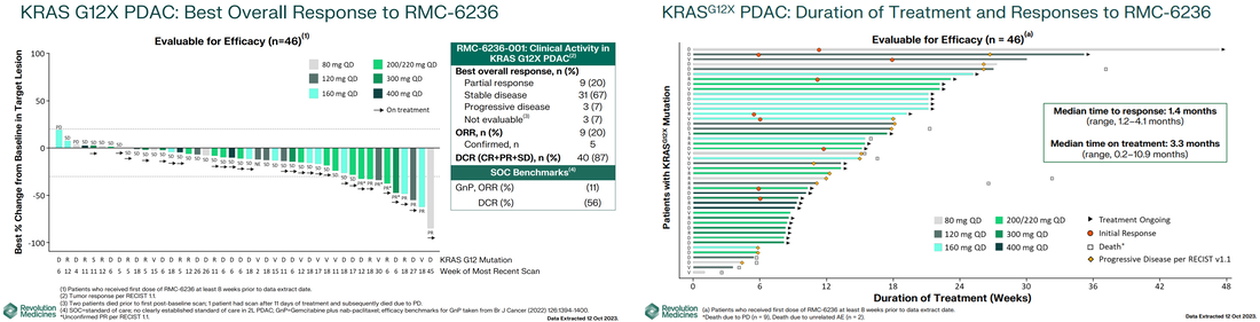
Slides from RevMed website
When interpreting these two graphs, it is important to understand a few points. First, different patients in the Phase 1 trial were treated with different doses of RMC-6236. The patients on the lowest dose levels have been treated the longest and most patients treated at the highest doses had only been treated for a few months when the data were reported. Responses were observed even in some patients treated with the lowest reported doses, but it is still hard to say what the best dose is. Second, these are early data. Most patients were still being treated at the time these data were released. Bars with little black arrows indicate patients who are still being treated on the study. That means that the slide is likely under-representing the true effect of the drug because many of the patient’s tumors should continue to respond as the trial progresses. Third, this trial is NOT controlled. There was no group that got standard-of-care therapy. So we don’t have a good comparison. However, experience suggests that these results are far better than you would expect from metastatic PDAC patients who have progressed on standard-of-care chemotherapy.
In fact, the data were so striking that Revolution Medicines announced on April 9 that they are planning a Phase 3 trial of RMC-7977 for patients with PDAC, with a goal of starting towards the end of the year. This is remarkable as it means they are not waiting for the results of a Phase 2 trial before moving to the final phase. Other trials (including Phase 2 trials) are likely in planning and could be launched even sooner.
Some frequently asked questions from patients
Can I enroll in the clinical trial? The Phase 1 trial of RMC-6236 remains open. We will not mince words – there are very few slots on this trial available and there are waitlists to get on it. The best option is to contact a participating site and inquire. The sites are listed at the clinicaltrials.gov webpage for this trial (NCT05379985).
As noted, a Phase 3 trial in PDAC patients is being planned. We suspect it will be for patients with metastatic disease who have progressed on standard-of-care, but this is speculation. It will hopefully start by the end of the year. Once more information is available, we will post it on this website.
I am very hopeful that one or more Phase 2 clinical trials will open sooner than the end of the year. I’ll definitely add info to this website if/when these are announced.
What are the side effects of RMC-6236? The Phase 1 clinical trial is not yet complete. However, so far the most common side effect is a skin rash, which occurs in the majority of cases. The rash can usually be managed, but it can in some cases be more severe (up to grade 3). The next most common side effect is gastrointestinal symptoms such as diarrhea, also generally manageable.
What is the difference between a RAS inhibitor and chemotherapy? Traditional chemotherapy targets rapidly growing cells by mutating DNA to such a degree that it causes the fastest growing cells to die. Unfortunately, this affects both tumor cells and normal proliferating cells such as those in hair follicles, the immune system, and the lining of the gut, leading to severe side effects. RAS inhibitors do not mutate DNA. Rather, they inhibit a protein that both tumor and normal cells need to grow and divide. Tumor cells rely on this protein more heavily than normal cells. So, while there are some side effects from a pan-RAS inhibitor, they should not be as severe as traditional chemotherapy.
What is the difference between RMC-7977 and RMC-6236? RMC-6236 is an investigational drug that is being developed by RevMed for use in humans. It is currently in clinical trials. RMC-7977 is a preclinical tool compound. RevMed makes this agent widely available to scientists so that they can carry out research on pan-RAS inhibition in different cancers without impacting the clinical development of their investigational agent. The two agents are closely matched in terms of molecular structure, pharmacology, and mechanism of action. Lessons from RMC-7977 should generally be applicable to RMC-6236.
Is it better to be treated with a mutation-specific KRAS inhibitor (like sotorasib or adagrasib or future drugs that are specific to KRASG12D, for example)? It is really hard to say at this stage. Mutation-specific drugs are likely to be better tolerated because they should not cause the side effects associated with inhibiting wild-type RAS proteins (e.g. rash and GI symptoms, primarily). However, mutation-specific drugs have only been developed for a few mutations and most PDAC tumors do not have those specific mutations. Also, it is possible that tumors treated with a mutation-specific RAS inhibitor can more easily develop resistance since all they need is for one cell to mutate KRAS in a different way and then it will no longer be inhibited by the drug. From this standpoint, pan-RAS inhibition might produce more durable responses (but this is speculation).
One possible strategy would be to start with the mutation-specific RAS inhibitor and then if/when the tumor developed resistance, try switching to a pan-RAS inhibitor. It might also be possible to develop combination regimens that use a higher dose of mutation-specific RAS inhibitor plus a lower (more tolerable) dose of pan-RAS inhibitor to attempt to prolong responses. But again, we are not MDs and this should not be taken as direct medical advice.
Is there other advice you would give to pancreatic cancer patients? There are three pieces of general advice we give to every patient.
Make use of resources provided by Pancreatic Cancer Action Network (PanCan). This wonderful non-profit organization is dedicated to supporting patients with pancreatic cancer and their family members. They have incredible resources and extremely knowledgeable staff. They can also help out with points 2 and 3!
Request genetic testing of your tumor. Some tumors have mutations that make them more susceptible to specific drugs. Knowing that information can change how you are treated. Get this done as early as possible after diagnosis. This requires a biopsy of the tumor, so if a patient is scheduled for a biopsy, definitely discuss genetic testing in advance of the procedure.
Consider participating in clinical trials. Patients in clinical trials tend to fare better than the average population of pancreatic cancer patients (likely because they have more contact with medical experts). Some patients fear clinical trials because they think they might receive a placebo. No clinical trials for pancreatic cancer have patients treated only with a placebo! Clinical trials can either be single-arm (meaning all patients are treated with the investigational therapy) or they are randomized between a new investigational therapy versus standard of care.
Final thoughts
The response from patients to the publication of our paper has been both gratifying and sobering. We desperately hope this agent (or other RAS inhibitors) prove to be effective in treating pancreatic cancer and that they quickly become available to all patients outside of clinical trials. Our entire team is driven by your urgency.