
"If you can't explain something simply, you don't understand it well."
"Everything should be as simple as it can be, yet no simpler."
-Albert Einstein
We strongly believe in the importance of clearly communicating our work to the public, without compromising the ideas through oversimplification. The following pages are an attempt to explain the work of our laboratory without retreating behind impenetrable jargon.
These pages will be a work in progress and updated regularly because science is always changing. We also hope that these pages will become a resource for patients and family members with pancreatic cancer who wish for a straightforward, clear, and accurate explanation of the disease. It will take some time, but ultimately we'd like to open this up to comments and questions to be answered or addressed by members of the laboratory.
-
Where the hell is the pancreas, anyway? I don't even know what the damn thing does beside give you cancer." -Hawk Hawkins (Tommy Lee Jones), Space Cowboys
OK, the pancreas is not exactly a high profile organ. We all have a pretty good idea of what our … read more
-
There are three different types of common pre-cancerous lesions known for pancreatic cancer. The first are "Pancreatic Intraepithelial Neoplasia" or PanINs. These are the small, non-fluid filled kind. There are different grades of PanINs … read more
-
Pancreatic cancer is one of the deadliest types of cancer, usually. I say usually, because ~95% of pancreatic tumors are classified as "pancreatic ductal adenocarcinoma", and these … read more
The Pancreas
Where the hell is the pancreas, anyway? I don't even know what the damn thing does beside give you cancer."
-Hawk Hawkins (Tommy Lee Jones), Space Cowboys
OK, the pancreas is not exactly a high profile organ. We all have a pretty good idea of what our hearts do, and our lungs, etc. But what's the point of a pancreas? To answer Hawk's question, the pancreas is located just below your stomach, next to where the stomach connects to your intestines (labeled duodenum in the diagram, which is the first part of the intestine).
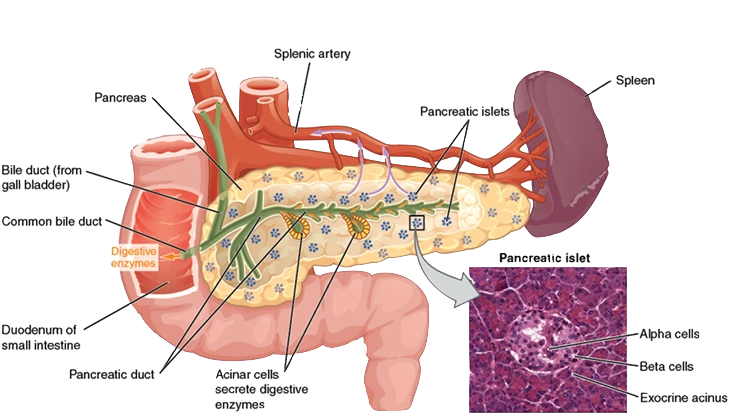
The pancreas performs two critical tasks. It produces digestive enzymes that help break down the food you eat, and it regulates your blood sugar by secreting insulin. Most of the pancreas is devoted to the first task: making digestive enzymes. The enzymes are produced by cells called "acinar cells", which form little bags throughout the pancreas. The bags (acini) dump the enzymes into tubes called ducts, which act as conduits to move the pancreatic juice to the intestine. A series of larger and larger ducts eventually join into the "common bile duct", which connects with a gasket structure in the wall of the intestine called "Ampulla of Vater" (or just Ampulla). The acini and ducts together are called the "exocrine compartment" of the pancreas ("crine" meaning to secrete, and "exo" meaning outward).
Scattered throughout the pancreas, are little collections of cells called Islets of Langerhans. These cells are responsible for the other function of the pancreas, regulating insulin levels. Many people are familiar with insulin in the context of another disease, diabetes. In diabetes, the body's ability to properly regulate insulin is diminished, resulting in sugar levels that are either too low, or too high. Insulin is secreted by islet cells directly into the blood stream, which is why this portion of the pancreas is called the "endocrine compartment" of the pancreas (meaning "to secrete inward").
Both of these functions are very important, but it IS possible to live without a pancreas. If your pancreas fails from disease, or if it is removed surgically, you will lose the ability to make certain digestive enzymes, and you will become diabetic. Pancreatic enzyme supplements can be taken to manage the first problem. The second problem is managed like anyone else with diabetes, through careful monitoring of blood sugar levels and self-administration of insulin. Unfortunately, removing the pancreas of a patient with pancreatic cancer is not always possible (because the disease has already spread). Furthermore, even when the tumor has not spread, surgery is not usually an outright cure for the disease. For more on this, please see the page on pancreatic cancer surgery.
[Frank, A., Deng, Sh. et al. 2004, Transplantation for type I diabetes: comparison of vascularized whole-organ pancreas with isolated pancreatic islets. 240: 631-643.]
Pre-cancerous lesions
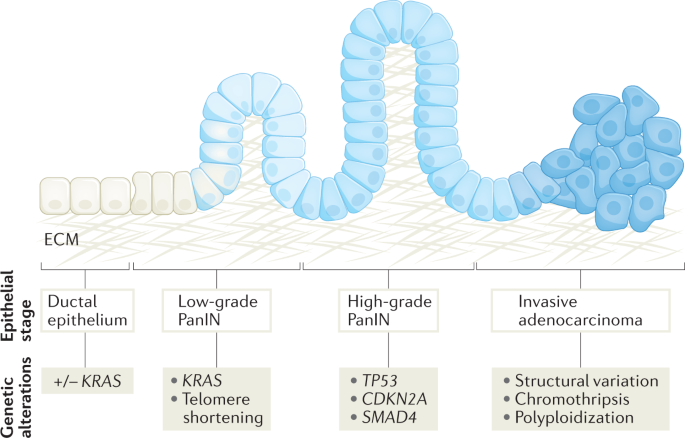
There are three different types of common pre-cancerous lesions known for pancreatic cancer. The first are "Pancreatic Intraepithelial Neoplasia" or PanINs. These are the small, non-fluid filled kind. There are different grades of PanINs, of increasing severity (low-grade to high-grade). The lower grade PanIN lesions are quite common in the population and most older people have at least a few. They are unlikely to ever cause any trouble. Conversely, high-grade PanINs are rare, but much more dangerous.
The other two types of pre-cancerous lesions are both larger fluid-filled types: Intraductal Papillary Mucinous Neoplasms, (IPMNs) are the more common of the two, and "Mucinous Cycstic Neoplasms". IPMNs vary in their location within the pancreas and their size, and these two features correlate with how dangerous they are. Luckily, IPMNs can be detected by imaging procedures, therefore making it possible to detect them before they become cancer. They are most often detected in patients who are routinely monitored due to a high familial risk, or incidentally in people who were imaged for another reason. If an IPMN is found in someone, a surgeon will have to make a determination as to whether it is a good idea to remove the lesion before it becomes actual cancer. This is a difficult decision to make because it involves balancing the risk of a patient developing cancer with the real risk of causing harm to the patient by removing a lesion that might never develop into cancer. This tough call is best made at a center that specializes in pancreatic cancer and sees a large number of pancreatic cancer patients.
"Mucinous Cystic Neoplasms" or MCNs are similar to IPMNs but, the principle difference between IPMNs and MCNs is how they look under a microscope, and how they behave in the patient (i.e. how likely they are to become cancer).
Pancreatic Cancer
Pancreatic cancer is one of the deadliest types of cancer, usually. I say usually, because ~95% of pancreatic tumors are classified as "pancreatic ductal adenocarcinoma", and these really are very serious tumors. The remaining ~5% of cases are tumors that start in the pancreas but are qualitatively different (either they have different genetic mutations or they originate from a different cell type within the pancreas). Some of these less common pancreatic tumors have better outcomes than ductal adenocarcinoma, though some can also be very serious. However, the focus of the Olive Laboratory is Pancreatic Ductal Adenocarcinoma (PDA), and all of the discussions on this site will focus on this type of pancreatic cancer.
Pancreatic cancer occurs when the cells that make up the exocrine compartment of the pancreas begin to grow and divide when they should not. These can lead to "pre-cancerous lesions", which are aberrant growths that are not yet cancer, but could become cancer someday. Some of these lesions form fluid-filled cysts that can be detected by imaging technologies such as CT or MRI, if they grow large enough. Others types of pre-cancerous lesions are smaller and cannot be detected by any current technology. A major area of research is to develop a blood test or other simple test to identify people who have these pre-cancerous lesions before they become cancer.
At some point, the cells that make up a pre-cancerous lesion may start to push outward into other parts of the pancreas, infiltrating the normal tissue. This is what distinguishes cancer from pre-cancer. The cells form an expanding ball within the pancreas called the "primary tumor" or "primary site". This tumor can cause trouble by itself, by blocking off the ducts that deliver enzymes to the intestine, by causing the rest of the pancreas to fail (thereby causing diabetes), by wrapping around blood vessels, or by bumping into other organs. It can also wreak havoc on the body's metabolism which can result in a wasting disease called cachexia. However, the most dangerous process is when the tumor cells spread through the rest of the body and form new masses in other organs. This process is called metastasis, and it is the acute cause of death in two thirds of pancreatic cancer patients.
-
Signs and symptoms of pancreatic cancer often don't occur until the disease is advanced. They may include: Pain in the upper abdomen that…read more
-
Before a surgeon performs surgery, they need to know some information about the patient. This includes cancer type, what stage the cancer is, location, etc. This information can be found…read more
-
Most pancreatic ductal adenocarcinoma patients who are not on clinical trials will currently receive one of three…read more